Key Terms Explained
Drug
Includes any substance or mixture of substances manufactured, sold or represented for use in— (a) the diagnosis, treatment, mitigation or prevention of a disease, disorder, abnormal physical state, or the symptoms thereof, in man or animal; or (b) restoring, correcting or modifying organic functions in man or animal.
Section 2 of the Food And Drugs Act, Chapter 30:01, refers.
Non-Prescription Drugs
Drugs that may be sold without a prescription under the supervision of a pharmacist at a pharmacy. These are classified as freely sold.

Over the Counter Drugs
Drugs that may be sold directly to consumers without a prescription, intended for self-medication of self-diagnosed, minor ailments. Over-the-counter (OTC) drugs may be sold in pharmacies as well as at any OTC-licensed establishment.
Pharmacy Board (Sale of OTC Drugs) Regulations, Pharmacy Board Act, Chapter 29:52, refers.
Third Schedule Drug
Drugs that are prescription-only drugs. They may be supplied only on the authority of a valid prescription issued by a physician, dentist, or veterinarian, as applicable.Division 1 of the Second Schedule of the Food and Drugs Regulations, Food and Drugs Act, Chapter 30:01, refers.
Controlled Drug
Drugs that are subject to additional controls due to their potential risks. They require a valid prescription and are regulated with more restrictive conditions on sale, distribution and oversight than other prescription-only or non-prescription drugs.
Division 2 of the Second Schedule of the Food and Drugs Regulations, Food and Drugs Act, Chapter 30:01, refers.
Narcotics
A narcotic is a substance that acts on the central nervous system to relieve pain, produce sleepiness or dull the senses. Based on these effects they have a very high potential for misuse, dependence and addiction. They are regulated with more restrictive conditions on sale, distribution and oversight than other prescription-only or non-prescription drugs. They are very highly controlled and are prescription-only.
Dangerous Drugs act, Chapter 11:25, refers.
Antibiotics
Antibiotics are drugs used to prevent and treat bacterial infections. They function by killing bacteria or inhibiting their growth and reproduction. Antibiotics are not effective against viral infections like colds or influenza. They are regulated with more restrictive conditions on sale, distribution and oversight than other prescription-only or non-prescription drugs. They are prescription only drugs.
Antibiotics Act, Chapter 30:02, refers.

Veterinary Drug
Drugs sold for veterinary (animal) use and includes a drug supplied on a prescription given by a veterinarian.
Regulation 32 of the Food and Drugs Regulations, Food and Drugs Act, Chapter 30:01, refers.
Deregistered
Drugs that are no longer approved by the Ministry of Health for use, sale, importation, or distribution. These drugs are considered illegal and their sale or importation is prohibited.
Division 3 of the Second Schedule of the Food and Drugs Regulations, Food and Drugs Act, Chapter 30:01, refers.
The information provided above is not intended for self-prescribing. Individuals are advised to consult a qualified healthcare provider before using any medication.
Frequently Asked Questions
- What is the purpose of the Drug Database?
-
The Drug Database is intended to provide general information on drugs approved for use within Trinidad and Tobago. The database does not replace formal regulatory processes.
- Does inclusion of a drug in the database mean it is approved for importation or sale?
-
Yes. However for antibiotics, narcotics and controlled drugs, all regulatory requirements are issued separately by the regulatory arms of the Ministry of Health.
- Can a person import a drug for personal use if it appears in the database?
-
Yes. However, antibiotics, narcotics, and controlled drugs are excluded. Persons seeking to import these categories of drugs for personal use should contact the Chemistry, Food and Drugs Division at cfdd@health.gov.tt for controlled drugs, and the Drug Inspectorate at druginspectorate@health.gov.tt for guidance regarding antibiotics and narcotics.
- How are drugs in the database classified?
-
The drugs listed in the database may fall under different regulatory categories, including controlled drugs veterinary drugs third-schedule drugs non-prescription drugs antibiotics narcotics Each category is governed by different regulatory controls, which are applied independently.
- Who should be contacted for official regulatory advice or approvals?
-
For regulatory requirements and guidance for antibiotics and narcotics, persons should contact the Drug Inspectorate at druginspectorate@health.gov.tt or via telephone at (868) 217-4664 extensions 13401–13418. For official guidance, approvals, or clarification of regulatory requirements, persons should contact the Chemistry, Food and Drugs Division at cfdd@health.gov.tt or via telephone at (868) 217-4664 extensions 13105/13116/13123/13130. The database should not be relied upon as a substitute for written regulatory advice.
- How to Read the Drug Database?
-
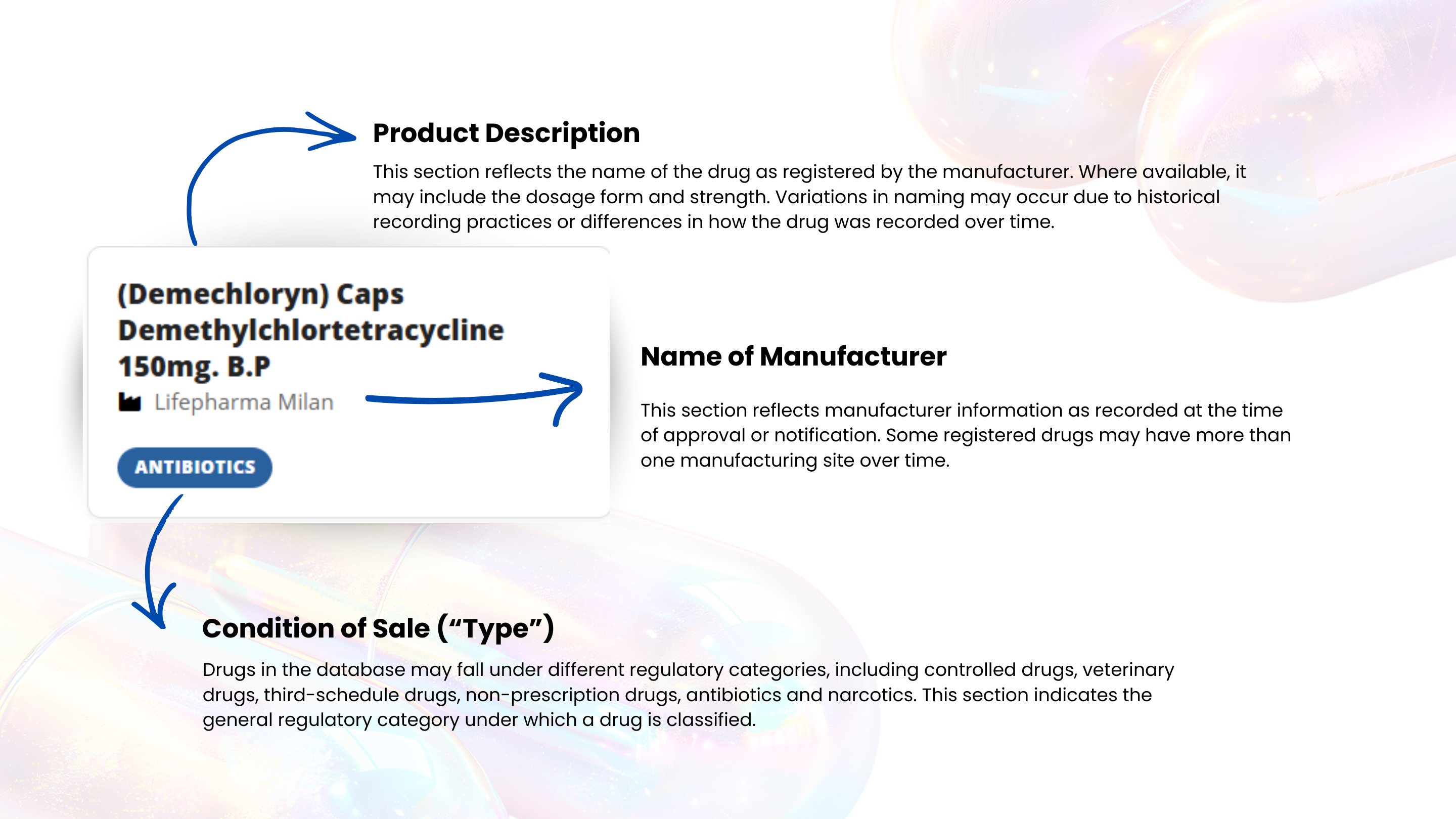
Drug Database
The database is updated regularly to ensure accuracy.
Antibiotics
Narcotics
Controlled Drugs
Official Notice
Chemistry Food and Drugs Division, Ministry of Health
The Ministry of Health seeks to provide accurate and up-to-date drug registered information on this site. Please contact the Chemistry, Food and Drugs Division if you have any queries. Please note that the appearance of any drug on this site does not mean the endorsement of same by the Ministry of Health.
Important Notice – Please Read Before Proceeding
The Drug Database is provided as an informational resource only.
Inclusion of a drug in this database does not constitute approval, authorisation or permission to import, manufacture, sell, dispense or distribute that drug.
Users should not rely on this database as a substitute for formal regulatory advice or written approval from the Ministry of Health.